AI Addiction
I started using computers in the 80s. We had a family computer that cost as much as a car, and I was allowed, even encouraged, to go wild on it. As a child, this meant playing and beating and replaying all kinds of edutainment titles. When we got a second family computer in 1994, the original one moved into my room and that’s where the tinkering started. Some of it could honestly qualify as programming, but most of it was simply remixing existing software with new words, colors, or other assets. Astonishingly, that computer was never online.
What I can say for certain is that from a young age, I was hooked on the process of editing something in software, running it, and watching the computer do the thing I wanted it to do. This is an incredible feedback loop that you can chase forever. As your skills increase, the potential for what you can make the computer do becomes greater, and the payoff for when it all works grows as well. Written out like this, it sure looks like an addiction, down to how you have to chase higher highs once the smaller ones don’t make you feel as good.
This is where I think a lot of folks are with AI right now. Especially those who use it to unlock or augment a skill they always wished they had. It’s easier for me to focus on AI use in programming, both because it’s what I know best, but also it avoids the thornier debates of AI use in more “creative” fields.1 I can certainly see AI unlocking the addictive feedback loop to a whole new cohort of technology enthusiasts. You don’t have to learn a coding language or take computer science courses in order to make an app anymore. Not only can an AI chatbot or agent do most (if not all) of the work for you, the industry has matured such that there are plenty of low-overhead options to handle the infrastructure of your app for you too, once it’s been created. If you were a “tech person” in the early days of app stores, every social gathering was bound to include some schmuck pitching you an app idea. Now they can all go out and do it themselves. And I think a lot of them are, and then getting addicted to what it feels like to have an idea for the computer to do something and then see it happen.
There is so much to be skeptical about with the AI market. Its negative impacts on the environment and supply chain for computer components are not up for debate. Neither is the fact that in training AI, an enormous amount of human creative output was consumed without credit or commission. Whether or not the output of AI is productive remains subjective, both in terms of slop and jobs, but I tend to fall on the side of a lot of it being junk. And I think that junk is starting to creep into software. Both in that existing software is being made more cheaply as AI is folded into its updates, and that new software is being released that nobody asked for in the first place. I am guilty of both.
I have been using Claude to help create apps and websites for over a year now. Initially, it was to make two existing software products better: Pastecard, my simple web and iPhone notes app, and my solo Twitter clone. I think it’s important to note that I made initial versions of all of these “the old fashioned way”: writing code by hand, searching for help with problems I didn’t know how to solve, and copying and pasting code from those search results without much new understanding. Last summer, using Claude, I rewrote all those services more or less from scratch to be more like modern software that runs on modern platforms.
It was my experience, and I understand it is for many others, that this process happens under some kind of Pareto principle: your initial prompt (if formed well) gets you 80% of the way there, and the remaining 20% of the project ends up taking 80% of the total time you spend on it. This is a long way of saying that the feedback loop is primed for quick hits.2 Your first prompt results in a working prototype that more or less does the thing you wanted it to do, and all it needs after is some refining?! If you get a dopamine hit from seeing the computer doing what you wanted it to do, why wouldn’t you keep pulling the casino lever that is asking the AI to do more? And if there are diminishing returns on dopamine hits within the same project, as the improvements get more incremental, wouldn’t you also get the itch to start a whole new project soon after?
And that’s where I’ve been this summer. I started with a native Mac app for Pastecard, which was complex enough for the full dopamine hit once it was finally finished. I would find myself going into the app’s settings and toggling things on and off, proud of this thing “I” had made, a big-computer app that felt more complex than a phone app. So once the shine started to wear off, I wanted to make another app for the big computer.
I had been collecting bookmarks since 2012 of things to buy, things to reference, all kinds of things that I didn’t want to forget but also didn’t want to show up in autocomplete when I was typing some other URL. The first decade’s worth of bookmarks were actual bookmark files, in a folder, on my backup hard disk. Double-click to open the URL. An insane person’s method for saving links. In 2023, I signed up for raindrop.io as a place to store bookmarks that was well reviewed and worked on all the things I had. But it is mainstream software, and it has to do so much to appeal to as many potential users as possible, and all I really wanted was a safe space to store links. So I asked Claude to build a simple Mac app for storing bookmarks, complete with an easily-exportable database and a built-in Safari extension to quickly save new ones from the only browser I use.
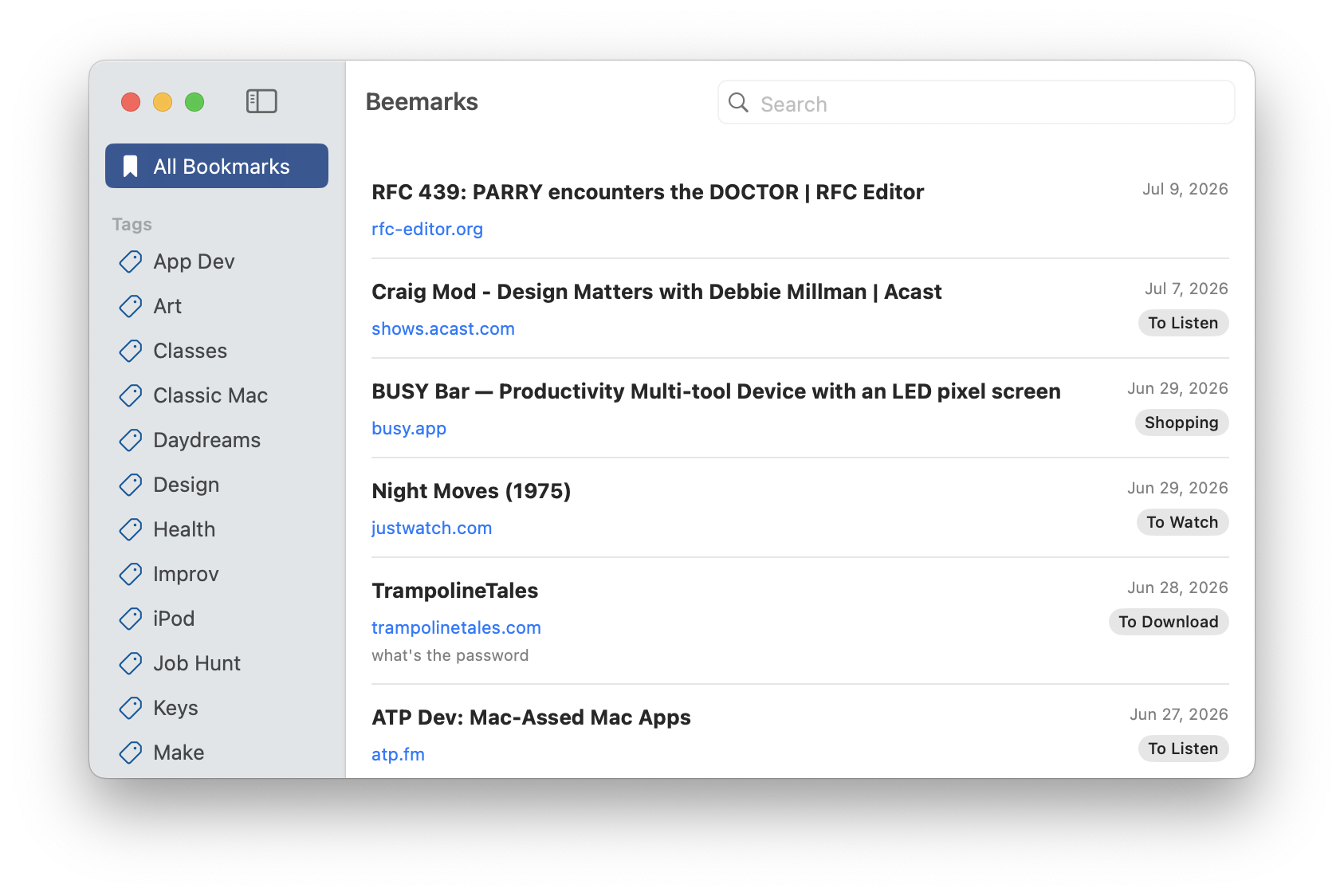
This definitely followed the Pareto principle, where the first prototype of the app is more or less unchanged through to today, and the bulk of the effort was getting the Safari extension to work. I’ve imported all the bookmarks that still existed from the two prior systems into this new one, and it feels great, and I also have no intention to put it out into the world. I got my dopamine hit from making it for me, and I still get little dopamine hits every time I use it, maybe because it’s only for me and it works so well.
Alas, the addiction must be fed, so I next asked Claude to map out a completely new app that has been in the back of my head for a long time. Once again, it was not a new idea, with plenty of established competitors, but I wanted my personal version of it to exist. And so I spent two months’ worth of free time working on Sepolev Neon: an iPhone app that turns a photo from your camera roll into a printed and mailed postcard. I did a lot of the user interface myself, but the mountain of interconnections behind the scenes that takes Apple Pay, and runs a credit card, and formats the mailing address and photo, and negotiates with the printing service, was all but handled by AI.
John Gruber was once part of a small team that made an iPhone notes app, and he gave himself the job title of Director while he was on that team. This was well before AI and vibe coding, and may even be more applicable now. It really is the perfect metaphor: the director of a film holds the entire vision, but it’s up to writers to make a script, actors to bring it to life, cinematographers to capture it on film, editors to hone the message, and so on. And so it was for my role in Sepolev Neon. I had the vision in my head the whole time, I chose the printer and the payment flow, and ultimately I’m on the hook if something goes wrong after taking someone’s real money. It all led to the same rush of making something out of nothing, and having that something work.
Maybe it’s worth noting that in the year that I’ve been using AI in earnest, I haven’t spent any money on it. I’ve only ever used the free plan at Claude. To extend the addiction metaphor, famously, the first taste is always free. It gets you hooked to the point of paying whatever it takes to keep it coming. AI’s economics are a whole can of worms, but it’s probably safe to assume that even with the enormous corporate valuations, they are still undercharging what it costs to run an AI business. And so, maybe after they’ve all gone public and are beholden to investor pressure, the costs of using AI will rise. And we will no longer have the same venture capital subsidy that we did just like the initial phases of Uber, Instagram, and others. What happens then, if we are well and truly addicted? Dependent, even?
 Because I use the free plan at Claude, I would easily hit usage limits and it would cut me off for a couple hours before I could start using it again. And my reaction to this was kind of shameful. First, I downloaded the Claude app to my phone so I could send a quick “please resume where you left off” chat when my access was restored, even if I was at work and away from the big computer. Worse, once while I was locked out of Claude, I went to ChatGPT to finish something I simply couldn’t wait for.
Thankfully my addictive behavior didn’t go beyond that, like how some people sink into dependent relationships with chatbots. I’m no prompt engineer, but it’s pretty clear to me that actually conversing with an LLM works better than treating it like a computer keyword machine. As someone who lives far away from my family and most of my friend groups, the main way I keep up with people is by typing in chats. So I see how that can start to feel like a real person is on the other side of the AI window, sending messages back to you in a similar interface as when you DM your friend.
Casey Liss wrote how using AI as a solo developer brings back some of the feeling of working together with teammates in an office setting. I mostly agree with the underlying sentiment, but I also see the danger in going too far down that road. I’m not saying it can veer into work spouse territory, though stranger things have certainly already happened. To be fair, I will sometimes send “thank you” or “that worked” messages, mostly in the hopes that they affirm what to do should a similar issue pop up later. I don’t really know if that’s the case, so maybe I’m just contributing to the tens of millions of dollars wasted on AI processing empty chats.
A lot of my thinking on this was inspired by Nilay Patel’s software brain essay. It’s from a more technical angle, positing that programmers get sucked into the AI feedback loop “if [their] operative framework is to flatten everything into databases that you can control with structured language.” That bookmarks app I made for myself is 100% that: a simple app wrapper around a database of links and their metadata. And arguably it’s the project from these summers of vibe coding that has given me the most satisfaction. So maybe I have software brain, and am susceptible to AI addiction. I hope that in recognizing the risk, and thinking about it to the extent that I wrote all this down,3 I won’t ever get that far.